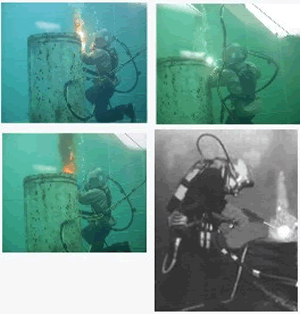
In ideal situations there is no substitution for the benefits afforded by welding in a dry atmosphere. Unfortunately, in the real world, repairs must often be effected in wet atmospheres. When wet welding is mandated the flux must remain dry during the welding process. After ten years of development, our new electrodes are coated with a high performnace proprietary waterproofing to ensure the flux remains dry for the best possible weld. |
|||
![]() |
![]() |
![]() |
![]() |
Model: MAG7014/X™ AWS E-7014, Class D.1, ASME SFA 5.1 (A-1, F-2), ABS—AWS A 5.1., D3.6 specification for underwater welding. Suggested amperage: 175 - 225 amps. Tensile: 70,000 tensile, 483-544 N/mm2. Yield: 60,000. Elongation: 17%. Weight: 10# (4.5 kg) per box. Diameters: 1/8" 3.2mm, 5/32" 3.9mm, 3/16" 4.7mm Great at filling wide gaps. Very fast deposition and excellent appearance. High tensile. |
Model: MAG6013/X™ AWS E-6013, Class D.1, AWS A5.1 ASME SFA 5.1 ZCWB—CSA W48.1. E41013. D3.6 specification for underwater welding. Run at 100—150 amps. 60,000 tensile, 414 - 450 N/mm2 50,000 yield, 22% elongation. Weight: 10# (4.5 kg) per box. Diameters: 1/8" 3.2mm, 5/32" 3.9mm, 3/16" 4.7mm Great for non-structural welding when economy is important. Easy deposition and weld appearance. |
Model: MAG0310/X™ AWS E-310 90,000 tensile, 621 - 675 N/mm2, 30,000 yield, 40% elongation. D.1, AWS A5.4, CLASS E 310, Stainless Steel. D3.6 specification for underwater welding. Grade 3 highest rating. Run at 125—175 amps. Weight: 10# (4.5 kg) Diameters: 1/8" 3.2mm, 5/32" 3.9mm, 3/16" 4.7mm For stainless steel or welding stainless, dissimilar metals or when harder welds are required. |
Number of electrodes per 10 pound box: The approximate number of electrodes per ten pound, 4.5kg box can be found in the table to the right. 1/8" 3.2mm = 100 electrodes. 5/32" 3.9mm = 80 electrodes. 3/16" 4.7mm = 60 electrodes. |
Information on wet welding electrodes |
|||
Covered electrodes are identified by the inner wire and the outer flux covering. The wire is generally matched to the material being welded. The flux is developed to provide a gas pocket to protect the weld against impurities. The formulation of electrode coatings is based upon the principles of metallurgy, chemistry and physics. The flux coating protects the metal from damage, stabilies the arc and improves the overall integrity of the weld. Benefits include improved deposition rate, penetration control, arc stability, splatter control, slag removal and how smooth the weld. Electrodes may be classified by their tensile strength, position of the weld and the current rated polarity. In underwater welding, straight polarity is the most common. The flux provides a gas shield to protect the weld. Basic types of flux coatings used in underwater welding include rutile and cellulose. Rutile electrodes are the most popular because they are easy to use, provide good mechanical strength and display acceptable visual appearance. Cellulose coated electrodes provide deeper penetration and rapid burn speed. All arc welding electrodes are identified by their AWS numbering. The first two numbers of an electrode indicate the tensile strength. Therefore, the AWS E-6013 electrode represents 60,000 psi tensile strength. The next to the last digit indicates the position the electrode can be used. E-XX1X indicates an all position electrode that can be used for flat, vertical, horizontal and overhead welding. Therefore, an E-6013 electrode can be used in all positions by virtue of the "1" following the tensile strength of 60,000 psi. Magnum only manufactures all position electrodes. The finaly digit represents the type of coating. (0) indicates ceellulose sodium. (1) indicates a coating of cellulose potassium. (2) indicates titania sodium. (3) indicates titania potassium. (4) indicates iron powder titania. (5) indicates low hi sodium. (6) indicates low hi potassium. (7) indicates iron oxide. (8) indicates Low hi iron powder. Our MAG6013X indicates a rutile flux electrode that can be used in all positions resulting in 60,000 psi weld strength. Our MAG7014X indicates a titania iron powder flux that can be used in all positions resulting in 70,000 psi weld strength. |
Amperage Settings Vary Amperage settings vary depending on the electrode diameter and the thickness of the plate. Welding is always done with DC current and for most purposes using straight (-) polarity (stinger negative). Negative polarity is good for vertical and overhead welding because the electrode is colder and thereby the weld material tends to stick to the kerf. Negative polarity also protects against electrolysis, a major cause for rapid deterioration of any metallic components in the stinger handle. Our most popular size is 5/32". The amperage setting ranges from 105 to 250. The thicker the material, the higher the amperage setting. Motor generator welding machines are the most common source of current used in underwater welding. The welding generator is grounded to the ship or platform. The circuit is controlled by a knife switch that is opened and closed for hot and cold status based upon the diver's command. Although wet welding is widely used around the world there are several special considerations e.g., water causes a rapid quenching of the weld. Rapid quenching raises the tensile strength of a weld and also promotes porosity and reduces impact resistance. Dissociation of water vapor in the arc region can contribute to hydrogen embrittlement resulting in cracks and microscopic fissures. For these reasons, the integrity of the flux is critical to the integrity of the weld. Wet welding electrodes must be completely sealed from the water. Magnum uses a new moisture proof dip coating to coat the electrode or rod for the ultimate in performance and shelf life. Poorly sealed electrodes cause difficulty with ignition, poor burning performance, excessive porosity and undercutting since the amps must be turned higher to offset the saturation. Post weld cracking can occur months later with disasterous consequences. The best approach is to coat an electrode so that saturation is minimal and the factory flux is maintained close to the original specification. Our tests indicate a significant reduction in what is referred to as hydrogen embrittlement using our sealing process. |
Underwater cutting and welding risks First and foremost the primary risk in underwater welding is the potential for electric shock. Secondly, there is the possibility of producing hydrogen and oxygen pockets as a byproduct of the electric arc which might combine to cause an explosion. Finally, the third risk involves the well known tendency for nitrogen to diffuse in the blood causing the bends. Since there are risks associated with underwater cutting and welding, dive school training is highly advised. Methods of underwater welding
SMAW (shielded metal arc welding) The most common process for underwater welding is SMAW and has been used for welding and repairing materials at depths of exceeding 600 feet. |
Underwater repairs
Wet weld standards Because much of the repair work is now done in wet atmospheres without enclosures, the adoption of underwater wet welding standards was critical for consistent and reliable quality assurance. The adoption of the ANSI/AWS D3.6 standard provided several benefits not the least of which was the ability of engineers to match an electrode with the scope of the fabricated structure. Four separate classes were adopted. Type A welds were compared with surface welds pertinent to enclosed or hyperbaric settings. Type B welds encompass noncritical applications where ductility and porosity are not a critical factor. Type C welds indicate welds which are not load bearing. Finally, type O welds indicate the same requirements as surface dry welds. For more information, review the AWS D3.6M-99 specification for underwater welding published by the American Welding Society dated April, 1, 1999. |
![]() |
![]() |
![]() |
|
Navigation
| Onshore | ||||

Hit "back" key to return to prior page.