blackhawk cutting products

Technical Cutting Information

The Ultimate Cutting Synthesis

Combustion Triangle

The Blackhawk cutting system operates on the principle of a combustion triangle. A solid combustible fuel resides inside the fuel tubes. When pure bottled oxygen flows through the tube filled with fuel, nothing happens. When this process is repeated and a catalytic 12 volt spark is introduced, an exothermic reaction is initiated which consumes the tube and fuel so long as sufficient oxygen flow is present. Although oxygen and the fuel are essential, the spark can be replaced using a chemical agent or an oxyacetylene flame. A pug tube field igniter can ignite a flame tube using a mere stick match in dry conditions. The cardboard tube generates sufficient heat with bottled oxygen to cause ignition in approximately five seconds.

Blackhawk™ Cutting Torch

A Blackhawk™ cutting torch is designed to deliver both oxygen and amperage upon demand to power both flame tubes and arc rods. For simplicity sake, we distinguish cutting consumables into tubes and rods. Tubes do not require voltage to run. Rods require a welder to perform cutting. Fortunately, our cutting torch is designed to operate both. The only difference is connecting a welding cable to the cable adapter at the base of the torch to power arc rods.

The most powerful cutting torch on the market today. The Blackhawk cutting torch accommodates both flame cutting tubes and arc cutting rods for the best of all working situations. One torch comes close to doing almost all.

The copolymer torch body is specifically designed to insulate the user when used in an arc cutting mode. The torch is also designed to extinguish the flame when the oxygen lever is released. For convenience, an oxygen regulator is employed at the base of the cutting torch so operators can adjust the flame while cutting. This feature is very handy so operators do not have to change their oxygen tank regulator settings.

Flame cutting tubes versus arc cutting rods

What is the difference? Flame tubes light with a 12 volt battery, oxyacetylene or a pug field igniter as indicated above. Flame tubes use a soft inner fuel so as to sustain ignition without any additional power source beyond the initial impetus. Therefore, there is no need for a welder when using a flame tube. Once ignited, the flame tubes will continue to cut, pierce or gouge until consumed or until the torch lever is released and the oxygen flow is thereby stopped. Since flame tubes do not require a welder assist, they do not need to be grounded. The absence of a power ground provides a cut through materials that do not conduct current.

Click here to for more information on our new battery ignition system

For example, rust, scale, paint, slag and concrete are non-conductive materials that a flame tube can readily melt because of its heat. The oxygen elevates the temperature of the burn and also provides a convenient means of blowing melted material away from the cut zone. The greater the oxygen pressure, the faster the cut. For controlled cutting, gouging or piercing, lower pressures suffice. A frequent question about the heat generated using a Blackhawk™ cutting torch is the overall heat introduced to the material. Speed is the answer. The torch cuts so fast there is less heat and changes to metallurgy. This result translates into better weld integrity.

Heat provides crucial benefits for the diverse needs of repair and maintenance. Flame tubes not only burn at ten-thousand degrees farenheit, they can be bent or angles for all position access. Imagine the time saved in cutting or piercing a bolt in a precarious position without taking apart adjacent equipment or parts. Flame tubes can pierce a hole in 4" plate in 4 seconds.Often flame tubes provide faster holes than drills in field fitting situations. Flame tubes also gouge so that welds can be removed. A linear foot of weldment can be removed in 8 seconds with the flame tube on its side. It flows across the metal like a feather duster. Clearly, this torch is designed for the rapidly changing needs of the modern world.

Flame cutting tubes are designed for the ultimate convenience. They ignite with a mere spark from a twelve volt battery or a simple field igniter using a match to generate ten thousand degrees of cutting performance to even melt through concrete.

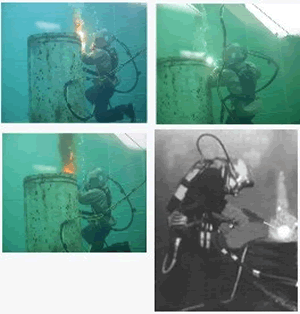
Flame tubes employ a copper clad outer jacket. For land there is no additional coating. For underwater, an adhesive spiral wrap or shrink coat provides insulation. The inner fuel has no carbon so very clean gouges can be effected generally without grinding prior to welding. Since flame tubes do not require continuous voltage they can be employed in tight spaces without concern of side arcing. Since flame tubes run without current they can be used for ductile pile, rock, concrete, plastic and more. Industrial settings are diverse. Nuclear power plants use flame cutting tubes to burn through cooling pipe bundles which are filled with crusty deposits. Dam engineers use flame tubes to perform maintenance on turbines and related infrastructure. Heavy equipment personnel use flame tubes for piercing pins or scarfing stress cracks prior to rewelding. Simply pierce the crack on both ends, gouge and weld. Flame tubes vary in diameter and length. Generally, the longer tubes are used specifically for piercing. A 24" equipment pin can be pierced through the center in as little as five minutes. Our video shows a 36" flame tube successfully piercing a 6" block of stainless steel. Since flame tubes burn underwater, they are also popular among divers around the world. Since there are no UV rays with a flame process, a number 5 burning lens is required for eye protection. Oxygen pressures vary depending upon the material. As a general rule, use the least amount of oxygen to accomplish a cut. Flame tubes will burn on as little as ten pounds of oxygen pressure.

Our Blackhawk arc cutting rods are designed to operate with a modest 225 amp welder to oxyarc cut a variety of materials suitable to scrap, dismantling and salvage. Cutting rods last up to twenty minutes.

Arc rods display a much harder inner fuel to effect a cut. Therefore, they must be used with a welding power supply. Although the use of a welding machine might seem a disadvantage, there is a significant benefit. The harder fuel allows cuts up to twenty minutes in duration. The longer duration makes arc rods ideal for scrap, dismantling and salvage. Since arc rods require a ground to conduct voltage they will not melt products that are non-conductive i.e., rocks, concrete and plastics. Arc rods use a pure copper outer tube coated with an adhesive spiral wrap or heat shrink coating to insulate against shock. The inner fuel involves a series of pure carbon spokes held in a radial configuration about the circumference using a crimp. The radial configuration provides a hole down the center to facilitate a jet stream of oxygen useful for blowing material from the cut.

If used underwater, only a DC power supply can be used. On land either DC or AC can be employed. The power requirements depend upon the thickness of the material. We recommend a 200 amp welder to power our arc cutting rods. Arc rods will operate; however, on as little as 125 amps. Arc cutting rods require no ignition. They automatically ignite when brought into contact with the grounded material. Since there are UV rays with any arc process, a number ten welder's lens is required. Arc cutting rods are never to be used underwater except by commercial divers with extensive experience in welding and cutting. In the initial states of our online video an arc rod is being used to cut through 2" plate in seconds. We used a 225 amp Lincoln DC welder as a power supply. Unlike air carbon arc cutting, our arc cutting rods operate quietly. They burn smooth and cut incredibly fast. Watch the video and see the power  in action. 

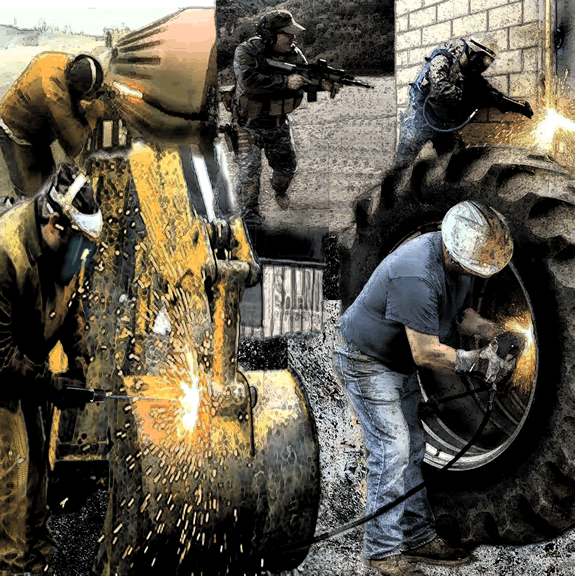
Good News for the overworked. One Blackhawk cutting system can outperform all of the alternate systems shown. Over 24 separate processes with a mere change in hand position. No acetylene, propane, mapp or gas. No welding power supply when using our flame tubes. No compressor required like carbon arc when using our arc rods. Unlike plasma arc, our consumables can be bent around corners and pierce up to 24" of metal. Get a Blackhawk and realize the immediate difference. Not more than you need, merely more than you have ever dreamed.

Magmafusion™ versus Plasma

In order to differentiate our flame cutting tubes from other processes, we shall be referring to our tubes as Magmafusion™. A plasma cutter uses either oxygen or air and cuts using current passing through a ceramic cone. The cones and nozzles are the consumable. There are numerous differences in terms of speed, power and versatility between a Magmafusion™ cutter and a plasma cutter. Our cutting torch shares speed and power in common with other popular tools used by discriminating consumers. Demand the best. Demand a Blackhawk™ cutting torch

Although there are numerous similarities, Magmafusion™  has numerous advantages over a plasma cutter. As we discussed earlier, flame cutting tubes do not require voltage to operate. Magmafusion™ is far faster than plasma-arc. Plasma cutters cannot cut through laminates. Magmafusion™ can easily cut through several layers of material. Plasma cutters work best on flat surfaces. Magmafusion™ works in any position and since it uses a cutting tube, the tube can reach into small places. This benefit often precludes dismantling parts to effect a repair. An air powered plasma cutter generates considerable noise. A Magmafusion™ cutter operates at a very low sound threshold. Government tests indicate a Magmafusion™ cutter makes the least noise of all cutting processes e.g., 57 decibels. For comparison, about as much sound as a 7018 welding electrode. Can you achieve the same cut with Magmafusion™ as a plasma? No. But the cut achieved with Magmafusion™ is well within re-weld tolerances.

Magmafusion™ versus air carbon arc

Where Magmafusion™ represents the quietest cutting process on the market, air carbon arc is undoubtedly the loudest. The federal government has restricted the use of air carbon arc to as little as twenty minutes per person per shift in mining settings. Air carbon arc uses a carbon electrode and an air compressor to effect a cut. The process has been long used for cutting wear manganese wear plates. With Magmafusion™ the same cutting tube can be used to cut thick or thin materials alike. Air carbon arc can require as much as a 600 amp welder to effect a cut on thick materials and a high c.f.m. air compressor. Therefore, you can generally forget using the process indoors. There is also a problem with eye injury. Anyone working in the general area can be subjected to UV rays and subsequent arc burn of the eyes. When you consider a Magmafusion™ flame tube can cut through any material using an oxygen bottle and a spark for the initial ignition, small wonder operators call it the miracle torch. Noise, smoke and the high voltage are concerns when using any piece of equipment. Magmafusion™ is several times faster than air carbon arc and does not contain carbon. Although air carbon arc is used for cutting and gouging, it can leave carbon in the gouge or cut. This is called carbon contamination. The effects include post weld cracking.

Magmafusion™ versus oxyacetylene

Oxyacetylene uses a dangerous gas called "acetylene," which is employed to elevate the flame temperature. Despite using acetylene, the maximum flame temperature under the best conditions are approximately half that of a Magmafusion™ cutting tube. The lower temperature prevents oxyacetylene from cutting many materials like cast iron, stainless steel and aluminum. Oxyacetylene, like air carbon arc cannot burn through laminates. Preheating is another problem encountered with oxyacetylene. Operators must first heat the metal prior to cutting. The preheating is not only a delay, it also changes the metallurgy. The most dramatic problem with preheating is metal fatigue and cracking adjacent to a weld. With Magmafusion™ there is no preheating. No dangerous gases to mix. No flame to adjust other than its length. No material barriers since a ten-thousand degree flame will even melt a rock. Oxyacetylene must be shut off using a specific sequence or the tips will pop and be destroyed. With our torch releasing the torch lever will immediately extinguish the flame. Neither air carbon arc or oxyacetylene can make the nice holes in thick materials like Magmafusion™. About the only thing a Magmafusion™ torch cannot be used for is heating.

This comparative discussion has been limited to our flame cutting tubes. Our arc cutting rods are slightly different. They are quiet, require no gases to mix, display low amperage requirements and also burn at a ten-thousand degree temperature like our flame cutting tubes. Therefore, there is no preheating. The main difference is they do possess carbon. Therefore, cleaning is required in a maintenance setting prior to re-weld. Since our arc cutting rods were primarily designed for scrap, dismantling and salvage, this is not a concern. Uses include scrap yards, ship dismantling and equipment salvage in a variety of settings. The fact our Blackhawk™ cutting torch operates both without any adjustment makes it the ideal tool in the cutting arsenal.

The preceding are but a few features differentiating our torch and consumables from other cutting processes currently employed on the market. This page is still under construction. Feel free to write with additional questions for a quick response via email. We sell to every imaginable industrial niche from nuclear power plants to government testing grounds. When it comes to repair, maintenance, scrap, dismantling and salvage, there is no faster, more powerful or more versatile cutting process on the market.


Copyright © 2007, Magnum Mfg. Inc.