|
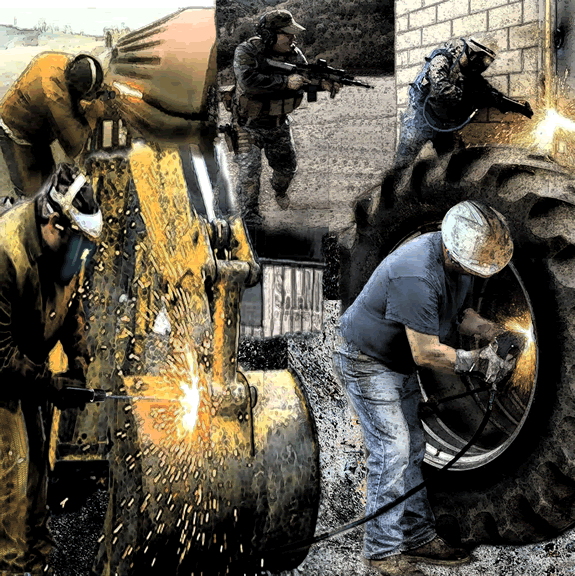
Having a DC welder on hand is essential for civil defense, tactical response, emergency response, or any form of emergency repair and maintenance assignment where portability and dependable power are required.

DC advantates:
- Easier stages.
- Fewer arc outages and sticking
- Less spatter for better looking welds
- Easier vertical and overhead welding.
- Smoother arc by virtue of direct flow current.
- DC reverse polarity (electrode positive) provides 10 percent more penetration at a given amperage than AC.
- DC straight polarity (electrode negative) welds thinner metals better.
How big a machine do I need?
- Most welding is done at currents lower than 200 amps.
- Small, portable welders suffice for most repairs.
- Large welders accommodate large electrodes.
- Multiple small welds are superior to single large welds.
- Thick materials can be welded by beveling the edges.
- Thick materials can be fused by using multiple beads.
- To change polarity reverse the red and black plugs.
What electrodes do I need?
- Small 3/32" electrodes are excellent for multiple passes.
- 6010, 6011, 6013, 7018 and 7024 are common electrodes.
- Flux characteristics influence speed, penetration and more.
- 6010 electrodes penetrate deeper than 6013 electrodes.
- 7018 yields better appearance, penetration and strength.
- Root passes use 6010 rod with cap beads using 7018.
- 7024 rods are "drag rods" capable of automatically maintaining the correct arc length due to thick flux, making it a favorite among repair and maintenance professionals.
Links to companion products:
Exothermic Ignitions
Cutting Consumables
Wet Welding Electrodes
Backpack Cutting Systems
|